Pro Engineer — sim racing telemetry and a virtual race engineer
It reads your telemetry and tells you what to change.
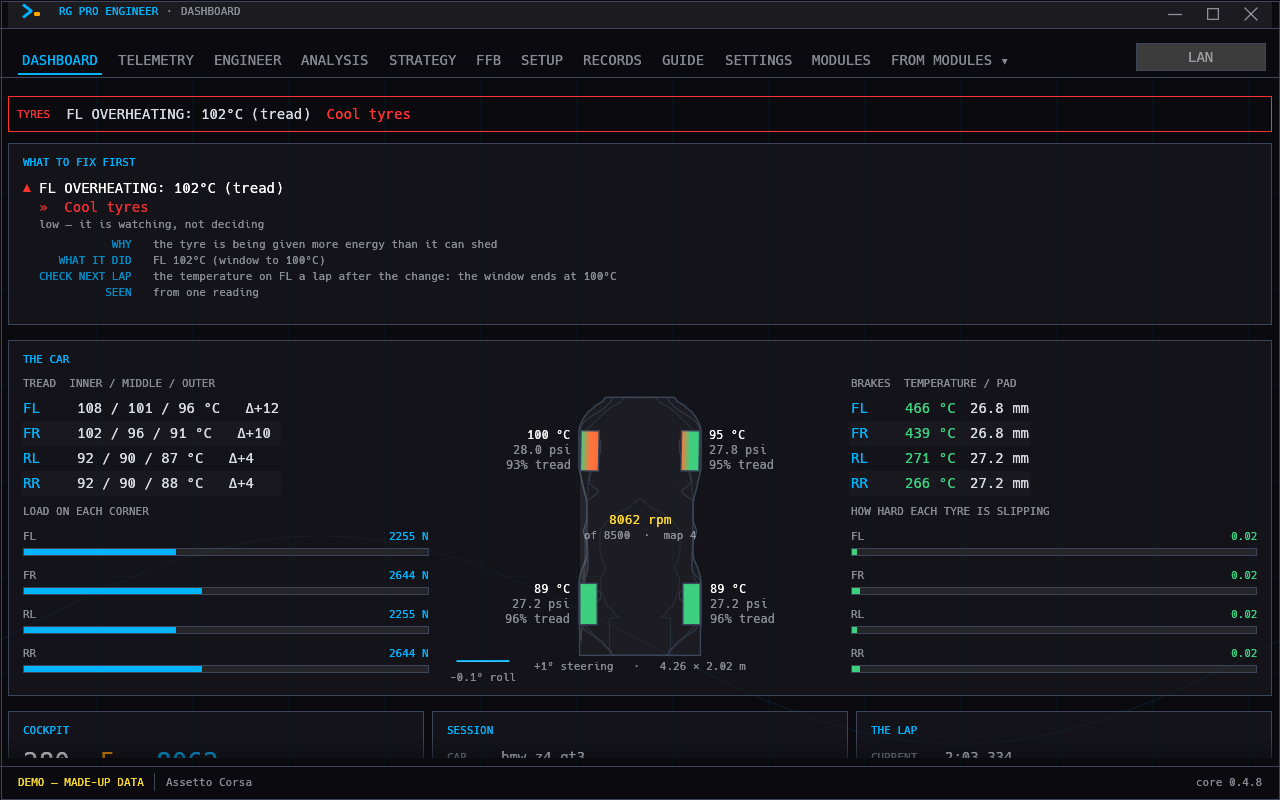
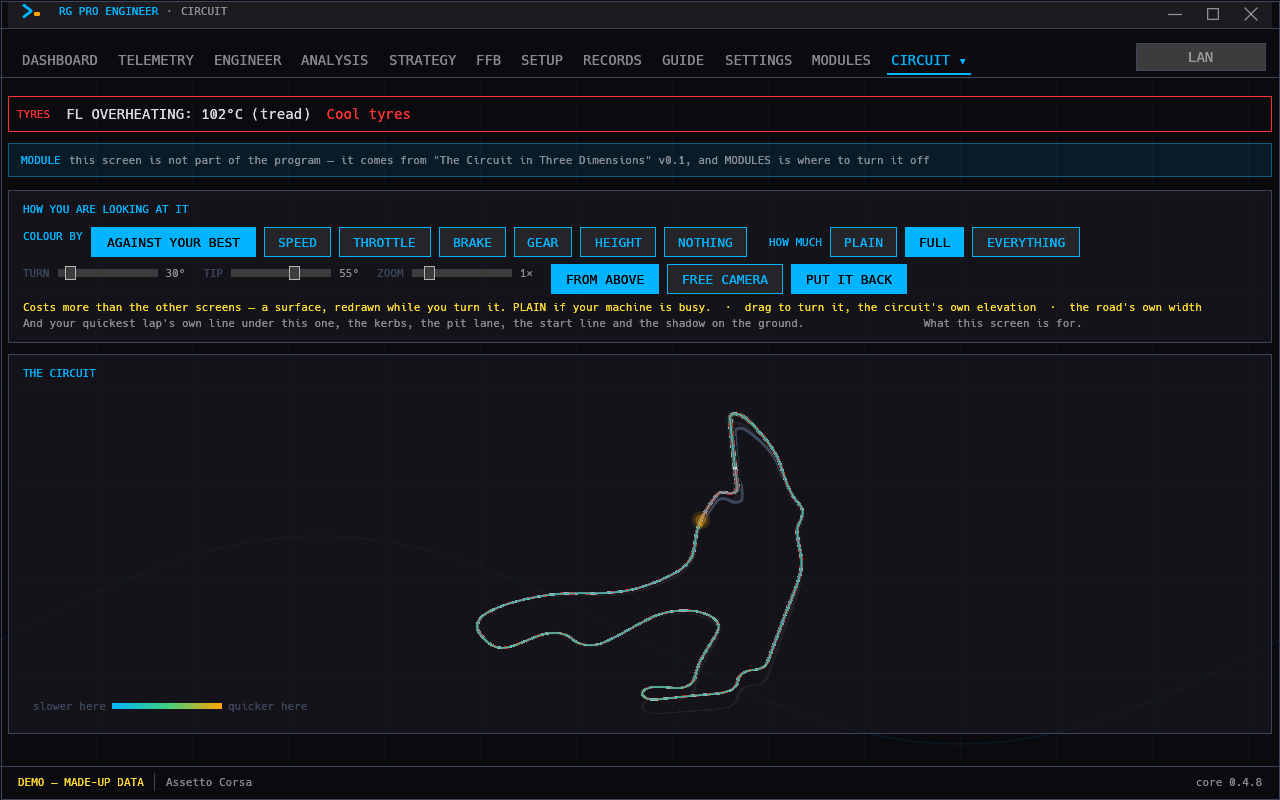
Two programs, one engineer. Pro Engineer is the terminal — the analysis in a text console, open source and free. RG Pro Engineer is the graphical one: a native desktop window with ten screens, plotted channels and the circuit drawn from the game's own files. Separate downloads, released together under one version, and everything that decides anything lives in one shared core — so the two can never tell you different things about the same lap.
Most telemetry tools hand you graphs and leave the interpreting to you. This one does the interpreting — "fronts over 28.4 psi, take 0.3 out" rather than a line on a chart — in a fast terminal on your second screen and inside the game. Free, open source, no account, and nothing about you leaves your machine.
WHAT IT ACTUALLY SAYS
Not a mock-up — these are the forms the engineer produces. The marker in front of each line is how sure it is, and the third one is it declining to guess.
● High
Several observations agreeing closely — four corners saying the same thing, not one odd frame.
◐ Medium
Enough to raise. Not enough to bet a setup change on.
○ Low
It is watching and has not decided. Being told that is worth more than a confident guess.
PICK YOUR SIMULATOR
A simulator is a folder under core/src/games/ rather than conditionals
through the middle of the engineer, so a second one is an addition and not a
rewrite. Two are written. Each says what it can and cannot measure, and the
program withholds the advice that rests on what it cannot — which is why the badges
here are three states and not two.
▸ Assetto Corsa FULL SUPPORT
Terminal dashboard, the race engineer, corner-by-corner analysis and a five-window panel inside the game through Custom Shaders Patch. Windows, Linux and Steam Deck.
Everything for AC▸ Assetto Corsa Competizione SUPPORTED
Since v0.4.0: dashboard, tyres, brakes, fuel and lap analysis, measured off a real session rather than transcribed, with the engineer judging a GT3 by a GT3's numbers. No in-game panel — CSP is an Assetto Corsa mod. What it measures and what it does not is written down.
Where ACC stands▸ Your simulator NOT YET
The boundary each game implements is small and honest about what it cannot measure — “not measured” and “measured as zero” are different answers. What it would take to add one is written down.
What a game has to provideREAD FURTHER
The detail lives on its own pages rather than in one long scroll, so you can go straight to the part you came for.
▸ Pro Engineer, in a window NEW
The same engineer in a window rather than a terminal: every channel plotted, the circuit and your car drawn from the game's own files, and findings that name the corner and what it cost.
See the window▸ Everything it does 218
The whole list, folded by area: tyres, the engineer, the debrief, corner analysis, ghosts and traces, driving style, fuel, force feedback, setups, the in-game panel, the built-in setup guide.
All 218 features▸ How it works
Shared memory read until two reads agree, one computed frame published to every front end, the Proton bridge, and why the in-game panel computes nothing at all.
Under the bonnet▸ Against the alternatives
Track Titan, Delta, RaceLab, SimHub, Crew Chief and MoTeC i2 — including the columns where this one loses.
The comparison▸ Download and install
Windows in one step, Linux and Steam Deck in two, and building it yourself in three. Plus what to do when the in-game panel stays blank.
Get it running▸ Questions
Is it free, will it cost frames, does it touch the game, can a friend watch, and what the licence lets you do with the code.
Nine answersNo account, no cloud, no subscription. Nothing leaves your machine unless you set an address yourself.